Equipment Planning
Precise and comprehensive: what defines a good specification
 Anyone preparing investments or working in technical procurement knows the significant difference between good and poor quotations. However, quality does not start with the bidder – it starts with the issuer of the tender.
The more precise the specifications, the better the quotations. Following this principle, LogistikPlan ensures a clear and comprehensive description of all requirements – both for the procurement of technical equipment and for its sustainable use. The benefits are obvious:
► Objectives of equipment planning:
- Completeness of the offered scope of services
- Transparency of terms, conditions, and prices
- Best possible comparability of bidders and quotations
► Tasks and procedure:
Within the scope of detailed planning, LogistikPlan determines the required equipment and specifies the operational equipment to be procured (e.g. production technology, warehouse technology, conveyor technology) in a precise and comprehensive manner.
Thanks to LogistikPlan’s manufacturer independence, we ensure that our clients’ interests in a technically optimal and economically viable system solution are safeguarded. We accompany the entire project process as a neutral partner of the client:
- Phase 3: Detailed planning
- Phase 4: Awarding
- Phase 5: Execution planning
- Phase 6: Realisation
- Phase 7: Commissioning and relocation
► Planning scope: system specification
At LogistikPlan, specification means the creation of detailed requirement descriptions that the client uses as a technical specification document for tendering to suppliers. Documentation is provided in the form of text, tables, and drawings.
► Determination of equipment requirements
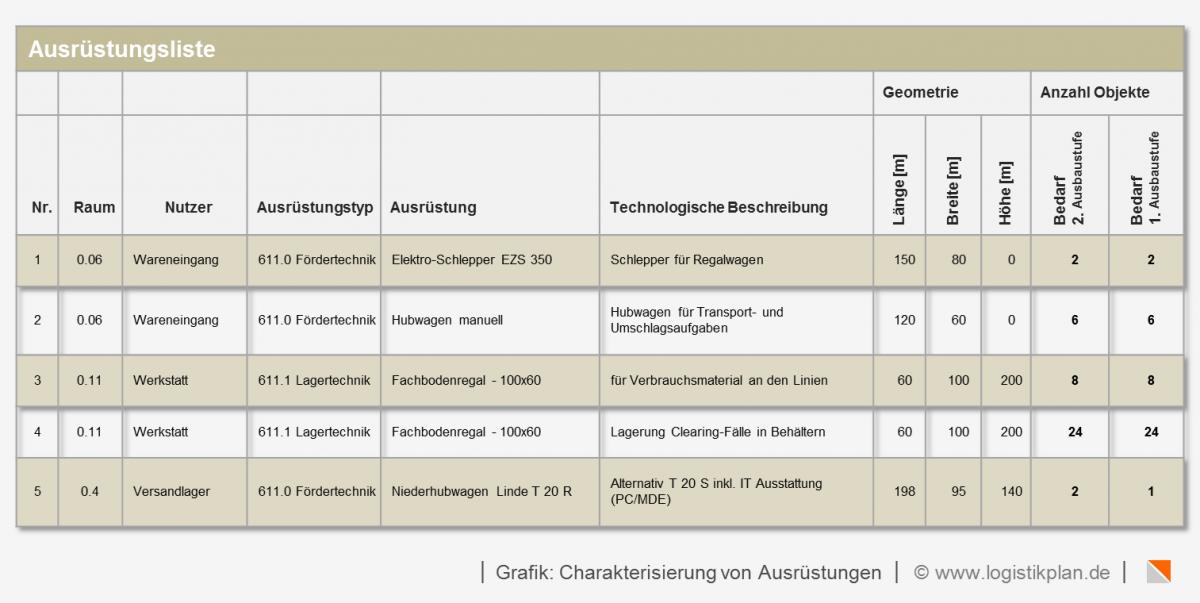
- Overview of all equipment data in the equipment list (LogistikPlan method standard)
- Consolidation of all utility connection data per piece of equipment in the utilities list (LogistikPlan method standard)
- Allocation of equipment and positioning of utility connections in the layout plan
- Comparison with existing equipment and derivation of procurement requirements
- Calculation of equipment costs (estimate, calculation, determination)
► Specification of equipment
- Storage systems, e.g.
- Pallet racking systems
- Bin or shelving systems
- Storage and retrieval machines for bin or pallet warehouses
- Buffer systems and special storage equipment
- Conveyor systems, e.g.
- Mobile conveying equipment (forklifts, tugger trains, tow tractors)
- Fixed horizontal conveying systems (material flow systems or sorters, e.g. roller conveyors, belt conveyors, plastic chain conveyors)
- Pallet conveyors, bin conveyors, carton conveyors, tray conveyors
- Overhead conveyor systems
- Trolleys and roll containers
- Automated Guided Vehicles (AGV), handling or picking robots
- Fixed vertical conveying systems (lifts, elevators, paternosters)
- Order picking systems
- Manual picking systems (e.g. pick-by-light, pick-by-voice, pick-by-vision, pick-to-bucket)
- Automated picking systems
- Sorting and handling systems for bin or pallet handling
- Packaging technology
- Packaging machines and systems for semi-automatic and fully automatic packaging
- Carton erectors and carton sealers
- Palletisers and depalletisers
- Stretch wrappers
- Production technology
- Specification of production machines and systems in cooperation with technical specialists (e.g. process or plant engineers of the client)
- Information systems
- Warehouse Management Systems (WMS)
- Material flow control systems (MFC) and forklift guidance systems
- Workstation equipment (e.g. for booking, scanning, coding, labelling)
► Results at a glance:
- Equipment list with all equipment data
- Utilities list with all connection data
- Layout plan showing equipment and utility connection positions
- Calculation of equipment costs