The LogistikPlan Project Process
Methodological Standard for Complex Projects
For the planning and implementation of Production Systems and Logistics Systems, LogistikPlan applies a proven methodological standard: seven consecutive project phases assigned to the individual project steps in Factory Planning, Logistics Planning, and industrial construction planning.
► Phase 1 │ Target Planning
- Target Planning serves for the Analysis of the current situation, target discussion, and Scenario evaluation.
- Based on the corporate strategy and business planning of our client, the fundamental principles for medium- and long-term Site Development are derived.
- Using Scenarios for future order structures as well as Manufacturing, Storage, and Shipping volumes, preliminary space and equipment requirements are roughly dimensioned.
- Site and building structures, fire compartments, traffic flows, and Material Flow are outlined and structurally optimized. Key functional areas are represented in a Block Layout.
- As a result of Target Planning, we define
- land requirements and expansion stages
- the technical and logistics base structure, as well as
- key economic and scheduling parameters of the overall project.
► Phase 2 │ Concept Planning
- In Concept Planning, Process, layout, and technical solutions are developed for each functional area. According to the current state of technology, Concept Variants are created.
- As the data basis for the concept phase, LogistikPlan develops a consistent quantity framework in order to align planned delivery and sales volumes with the corresponding Manufacturing and Storage capacities.
- In parallel with the layout and equipment concept, another key focus is the conceptual design of the Logistics IT system.
- The concept results are jointly evaluated in a results workshop in order to select the preferred Variant based on customer-specific criteria.
► Phase 3 │ Detailed Planning
- After approval of the preferred Variant by the client, the concept results serve as input for Detailed Planning.
- At LogistikPlan, Detailed Planning typically includes the following focus areas:
- definition of requirements for the site and infrastructure, structural and civil engineering works, as well as building services
- comprehensive equipment planning for Production and Logistics areas
- specification of all newly procured Production and Logistics equipment
- detailed planning of Processes and workstations as well as requirements for Production and Logistics IT systems
► Phase 4 │ Tendering and Contract Award
- During the Contract Award phase, suppliers for the implementation of the planned systems are selected – from prequalification of bidder candidates through offer evaluation and bidder negotiations to contract definition.
- LogistikPlan provides technical and logistics Consulting, offer evaluation, and Contract Award recommendation.
- Unless otherwise agreed, the client remains responsible for the procurement and award process, including commercial and contractual matters.
► Phase 5 │ Execution Planning
- Project implementation begins after the building permit has been granted with the execution planning for the equipment.
- LogistikPlan is responsible for
- technical and logistics Consulting for the client,
- monitoring of the planning activities performed by equipment suppliers, and
- approval of functional specifications.
- In parallel, detailed coordination with the involved construction planners takes place.
► Phase 6 │ Execution
- During this phase, LogistikPlan provides Implementation Support.
- The implementation of the contracted delivery and Assembly services for all logistics equipment, Production machines, and workstations is generally carried out step by step depending on the progress of construction.
- LogistikPlan takes responsibility for
- monitoring and acceptance of logistics-related equipment installations
- technical and scheduling coordination of logistics subprojects, as well as
- optionally the coordination of the overall project as part of Project Management.
► Phase 7 │ Commissioning
- The Commissioning phase includes inspection and acceptance of the installed Logistics Systems by LogistikPlan acting as supervising authority.
- Subsequently, we support the client during the ramp-up phase and assist with training of shift personnel.
- For target–actual comparison, we evaluate the fulfillment of selected performance parameters in Manufacturing and Logistics.
- The project concludes with the final documentation and handover of the project documentation to the client.
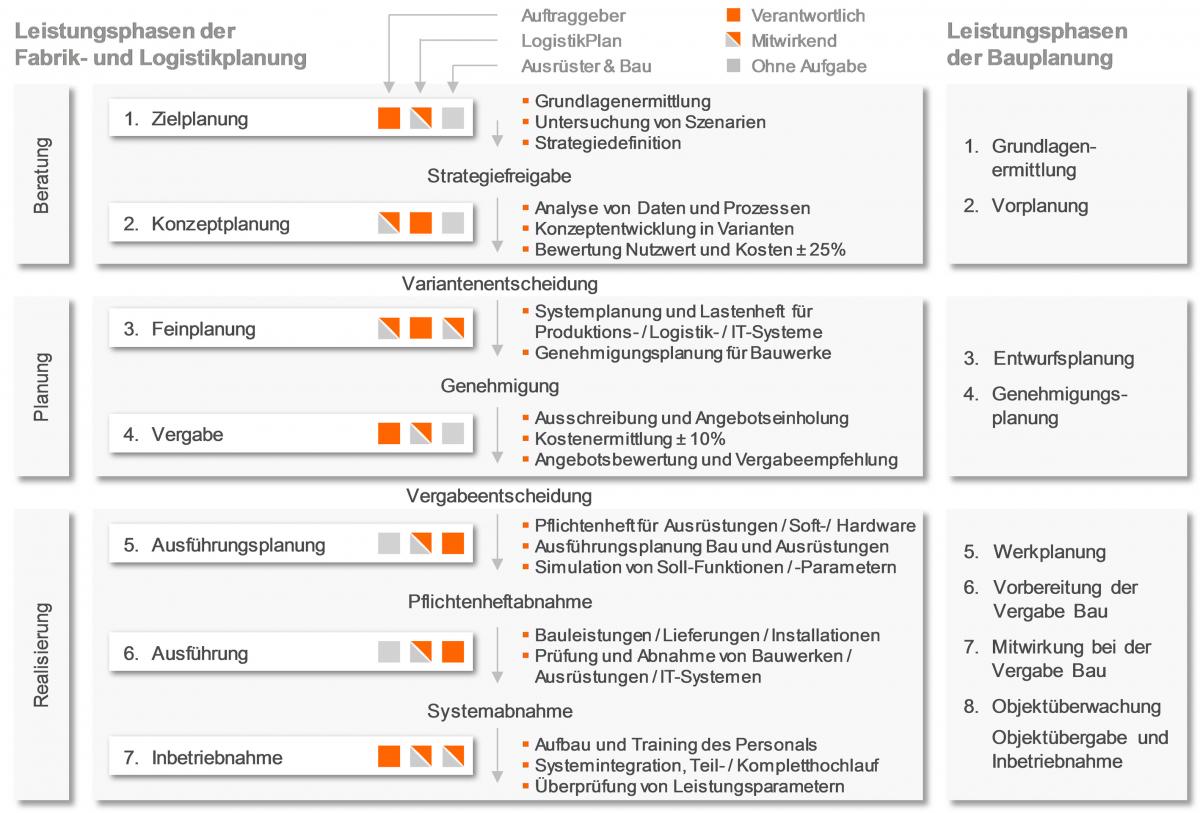
With the LogistikPlan Project Workflow, we provide our clients with comprehensive support – from strategy definition through Concept Planning and Detailed Planning to implementation. The advantages are clear:
- a consistent framework for all project participants
- clear division of responsibilities in each Project Phase
- defined milestones and results.