Capacity Planning
Master Planning for the Future
 When it comes to major budget decisions, a look into the famous “crystal ball” does not really provide clarity. Before investing in a new production hall, automation or warehouse technology, solid figures need to be on the table.
Despite uncertain forecasts and volatile external conditions, long-term planning of capacities and expansion stages should not be decided ad hoc. Instead, it should be calculated by controlling or corporate planning within a consistent planning model.
► Think ahead – act entrepreneurially.
- Larger companies use a corporate planning model as part of their cross-site corporate strategy, for example
- as an investment program planned in fixed cycles or on a rolling basis,
- as a five-year production plan, or
- as a business forecast.
- Forward-looking capacity planning is no witchcraft even for mid-sized companies: you provide the forecast, LogistikPlan provides the method.
► The LogistikPlan Planning Model
For capacity planning, LogistikPlan uses its own proprietary tool, developed over many years, for dimensioning and master planning of production and logistics systems: the LogistikPlan Planning Model.
Functions at a glance:
- Calculation of historical volumes (e.g. for procurement, production, sales)
- Differentiated forecasting of demand volumes (e.g. with variable trends by product range)
- Conversion of production units into logistics units (e.g. containers, packages, transport lots)
- Mapping of limited or unlimited resources (machinery, space, personnel)
- Modeling of holistic scenarios (procurement / production / sales scenarios)
- Time series with annual ramp-up volumes or ramp-down volumes
- Visualization of utilization rates for over- and under-capacity forecasting
- Evaluation of investment requirements and process costs per scenario and year
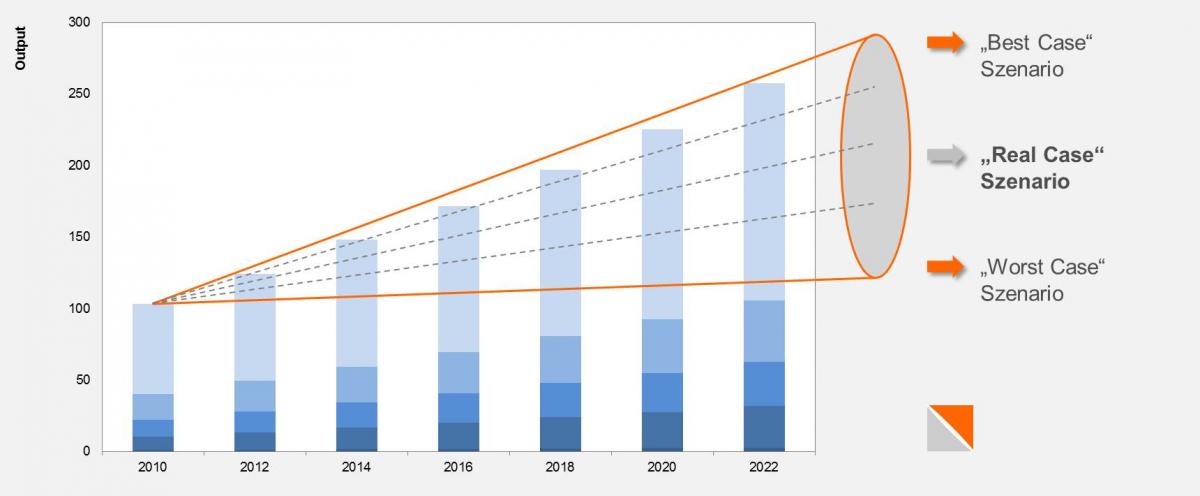
The future at a glance. Results of LogistikPlan consulting:
- Strategic decision basis for investments in resources
- Scenarios for site development with evaluation of capacities, space and costs, including outsourcing costs
- Evaluation of investment costs and process costs
- Data basis for master planning with expansion stages for individual operating units
- Applicability for rolling forecasts and capacity planning
- Handover of the model (software: Excel and VBA) for continued use by the client